
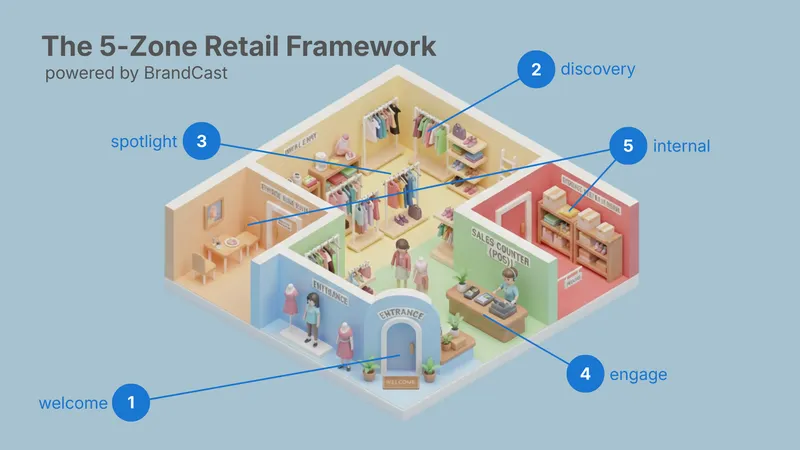
In-Store Messaging Strategy: The 5-Zone Framework
Every time a customer walks into your store, two stories are happening at once. Your in-store messaging strategy determines whether they connect.
There’s your story: the promotion you’re running, the product you’re pushing, the message you need them to hear.
And there’s their story: the question they walked in with, the decision they’re trying to make, the problem they’re hoping you’ll solve.
Most stores only tell one story: theirs. They blast promotions at customers who aren’t ready to hear them. They stay silent when customers are desperate for guidance.
The stores that win? They tell both stories at once, in every zone.
Two People, One Store
Let’s follow two people through the same store, at the same time.
Meet Sarah. She owns a home goods boutique. She’s running a spring promotion: 20% off outdoor furniture. She needs to move inventory before summer stock arrives. She’s stressed about making rent. And her staff keeps forgetting to mention the assembly service.
Meet David. He just moved into a new apartment. His patio is empty. He walked past Sarah’s store and thought, “maybe they have something.” He has 20 minutes before his next meeting.
These two people need each other. Sarah has exactly what David wants. David is exactly the customer Sarah needs.
But will they connect? Let’s walk through all five zones.
Zone 1: Welcome
The entrance. The storefront. The first 30 seconds.
Sarah’s Story (The Owner)
“I need people to know about the spring sale immediately. We’ve got 30% of our outdoor inventory left and three weeks to move it. If someone walks in, they need to know this is THE moment to buy patio furniture.”
David’s Story (The Customer)
“Okay, I’m walking in. Cute store. Do they have outdoor stuff? I don’t want to wander around for 10 minutes if this is just candles and picture frames. Give me a sign. Literally.”
The Disconnect
Sarah puts a generic “Welcome!” slide on her entrance display. It’s friendly. It says nothing.
David walks in, sees a nice store, has no idea if they have what he needs. He’s already calculating how quickly he can leave.
The Connection
Sarah’s entrance display says: “Spring Patio Sale: 20% off all outdoor furniture. Back left corner.”
David thinks: “Perfect. Back left corner. Let’s go.”
What changed: Sarah answered David’s real question (“do you have what I need?”) instead of just saying hello.
This matters more than you think: 8 out of 10 customers have entered an unfamiliar store specifically because a digital sign caught their attention. Your Welcome zone is often the difference between a browser and a buyer.
Zone 2: Discovery
The aisles. The browsing areas. Where customers explore their options.
Sarah’s Story (The Owner)
“People browse but don’t buy. They look at the furniture, check the price tags, and leave. I know our prices are good, better than the big box stores for this quality. But I can’t follow every customer around explaining that.”
David’s Story (The Customer)
“Okay, here’s the outdoor section. Lots of options. Where do I even start? I need something for a small patio. Are these all the same quality? I don’t want to spend 20 minutes comparing every chair.”
The Disconnect
Sarah relies on price tags and hopes David figures it out. He’s overwhelmed. He gravitates to the cheapest option because it’s the only decision he can make quickly.
The Connection
A display in the outdoor section says: “Small patio? Start here. Our bistro collection is made for apartments: compact, weather-resistant, and under $200.”
David thinks: “Oh, that’s me. Let me look at these.”
What changed: Sarah helped David navigate his options instead of leaving him to wander.
Zone 3: Spotlight
The endcaps. The feature displays. Premium placement for premium offers.
Sarah’s Story (The Owner)
“I have this one chair. It’s our best seller, great margin, and customers love it once they see it. But it gets lost in the sea of options. I need to PUSH it.”
David’s Story (The Customer)
“Okay, I’m looking at bistro sets. This one’s nice. Wait, what’s that over there? That chair looks really good.”
The Disconnect
Sarah’s best chair sits in a row with 15 others. David might find it. He might not. It’s luck.
The Connection
An endcap display with the chair front-and-center says: “Our #1 Seller. This chair is $180 here vs. $240 at big retailers, and we assemble it for free. No six-week wait.”
David thinks: “Oh. That’s actually a great deal. And they assemble it? Sold.”
What changed: Sarah actively PUSHED her best offer at the moment David was ready to hear it.
The data backs this up: digital signage can increase the average purchase amount by 29.5%. But only when you put the right message in the right spot. A Spotlight zone turns “browsing” into “buying.”
Zone 4: Engage
The checkout queue. The waiting line. Captive time to build the relationship.
Sarah’s Story (The Owner)
“I wish more customers joined our loyalty program. It’s a good deal, 10% off your next purchase, but nobody signs up. I remind the cashiers to mention it, but it’s awkward and they forget.”
David’s Story (The Customer)
“Great, I’m buying the chair. Happy with this decision. I’ll probably need more stuff once I see how it looks on my patio. I wonder if they have… no, I don’t have time to browse more today. Maybe I’ll come back.”
The Disconnect
David pays. The cashier says “thanks!” David leaves. He never comes back. He forgets the store exists by the time he needs a side table.
The Connection
The checkout display says: “Love your new chair? Join our free rewards program and get 15% off your next purchase. Most customers come back for the matching side table.”
David thinks: “A side table would be good. And 15% off? Yeah, sign me up.”
What changed: Sarah used David’s captive time to build a relationship, not just close a transaction.
Here’s a bonus: digital signage reduces perceived wait times by up to 35%. David doesn’t just sign up for the loyalty program. He leaves feeling like the checkout was faster than it actually was.
Zone 5: Internal
The breakroom. The stockroom. Where your team gets aligned.
Sarah’s Story (The Owner)
“My staff is great, but they don’t always know what to push. They forget about the assembly service. They don’t mention the sale unless someone asks. I can’t be here every shift to remind them.”
The Staff’s Story
“I want to do a good job, but I don’t always know what’s on sale or what I should be mentioning. I find out about promotions when customers ask me about signs I haven’t seen.”
The Disconnect
Sarah sends an email about the spring sale. Half the staff doesn’t read it. The other half forgets by their next shift.
The Connection
The breakroom display shows: “TODAY’S FOCUS: Spring Patio Sale (ends Sunday). Goal: 5 assembly service mentions per shift. Tip: ‘We’ll put it together for you, free!’ is our best closer.”
Staff thinks: “Oh, I should mention the assembly service. Got it.”
What changed: Sarah’s team showed up informed, aligned, and ready to support the customer experience.
The 5-Zone Framework
Every zone has two questions: one from you, one from them.
| Zone | Owner’s Question | Customer’s Question |
|---|---|---|
| Welcome | ”How do I get their attention?" | "Do you have what I need?” |
| Discovery | ”How do I help them explore?" | "What are my options?” |
| Spotlight | ”How do I push my best offer?" | "What’s special right now?” |
| Engage | ”How do I build the relationship?" | "Tell me more while I wait.” |
| Internal | ”How do I keep my team aligned?” | Staff: “What do I need to know?” |
Your job: Answer their question in a way that serves your goal.
That’s it. That’s the whole framework.
Zones Are Strategies, Not Just Locations
Here’s something important: a zone isn’t always a single screen in a single spot.
You might have multiple Discovery zones: one in your outdoor furniture section, another in kitchenware, a third in seasonal items. Each one serves the same purpose (helping customers explore their options) but lives in a different part of your store.
You might have multiple Spotlight zones: an endcap near the entrance, a feature display in the back, a promo rack by checkout. Each one pushes a different priority product.
Think of zones as communication strategies that happen to be tied to physical areas. The strategy is consistent. The locations can vary.
| Zone Type | One Location? | Multiple Locations? |
|---|---|---|
| Welcome | Usually one (the entrance) | Maybe two (front + side door) |
| Discovery | Often multiple (per department/category) | Yes, each browsing area gets one |
| Spotlight | Often multiple (premium spots throughout) | Yes, wherever you want to PUSH |
| Engage | Usually one (checkout) | Maybe two (checkout + service counter) |
| Internal | Usually one (breakroom) | Maybe two (breakroom + stockroom) |
The key insight: You’re not assigning one screen to one zone. You’re deciding what kind of conversation each screen should have, then grouping them by purpose.
Discovery vs. Spotlight: Know the Difference
These two zones often get confused. Here’s the distinction:
| Discovery | Spotlight | |
|---|---|---|
| Who’s leading | Customer is self-directing | Store is pushing |
| The tone | ”Here are your options" | "Don’t miss THIS” |
| The placement | General aisles, category areas | Endcaps, premium spots |
| The goal | Help them navigate | Drive specific action |
Discovery is a map. Spotlight is a billboard.
You need both. Discovery keeps customers engaged. Spotlight moves your priority products.
Why This Works
The numbers are striking: retailers using digital signage report an average 32% increase in sales. Digital displays capture 400% more views than static signs. And the recall rate is 83%, more than double print.
But here’s the catch: those numbers assume you’re saying the right thing at the right time. A screen showing the wrong message in the wrong zone is just an expensive decoration.
When you only tell your story, you’re shouting into the void:
- “SALE SALE SALE!” (Customer: “Sale on what? Do I care?”)
- “Welcome to our store!” (Customer: “Okay… now what?”)
- “Follow us on Instagram!” (Customer: “Why would I do that?”)
When you tell both stories, you’re having a conversation:
- “Looking for outdoor furniture? It’s 20% off, back left corner.” (Customer: “That’s exactly what I need.”)
- “Small patio? Start with our bistro collection.” (Customer: “Oh, that’s me.”)
- “This is our #1 seller, $60 less than the big box stores.” (Customer: “Sold.”)
- “Most customers come back for the side table. Here’s 15% off.” (Customer: “Good idea. Sign me up.”)
Building Your 5-Zone System
Step 1: Map Your Zones
Walk your store. For each zone type, identify every location where that conversation should happen:
- Welcome: Where do customers enter? (Front door, side entrance?)
- Discovery: Where do they browse? (List each department or category area)
- Spotlight: Where are your premium spots? (Every endcap, feature display, promo rack)
- Engage: Where do they wait? (Checkout line, service counter, fitting room queue?)
- Internal: Where does your team gather? (Breakroom, stockroom, back office?)
Remember: You’re not limited to one screen per zone type. A store with 10 screens might have 1 Welcome, 4 Discovery, 3 Spotlight, 1 Engage, and 1 Internal.
Step 2: Map Their Questions
At each zone, ask: “What is my customer wondering right now?”
- Welcome: “Is this store for me?”
- Discovery: “What are my options?”
- Spotlight: “Is this worth paying attention to?”
- Engage: “Did I make a good choice? What’s next?”
- Internal: Staff: “What should I be pushing today?”
Step 3: Map Your Goals
At each zone, ask: “What do I need to happen here?”
- Welcome: Direct traffic to priority areas
- Discovery: Help them find the right product
- Spotlight: Push high-margin or time-sensitive offers
- Engage: Capture loyalty, drive repeat visits
- Internal: Align staff on daily priorities
Step 4: Write Messages That Serve Both
Each message should answer their question AND advance your goal. If it only does one, rewrite it.
Common Mistakes
Telling Only Your Story
“20% OFF EVERYTHING!” doesn’t answer “do you have what I need?” It’s your story, not theirs.
Treating Discovery Like Spotlight
If every aisle is screaming “BUY THIS NOW!”, nothing stands out. Save the urgency for your Spotlight zones.
Ignoring Internal
Your staff can’t sell what they don’t know. The breakroom screen isn’t a nice-to-have. It’s how your whole system stays in sync.
Same Message Everywhere
If your Welcome and Engage zones say the same thing, you’re ignoring the journey. Their questions change as they move through your space.
Key Takeaways
- Every visit is two stories: yours and theirs
- 5 zones, 5 conversations: Welcome, Discovery, Spotlight, Engage, Internal
- Discovery helps them explore. Spotlight pushes your priority.
- Don’t forget Internal. Your team is part of the system.
- If you’re only telling your story, you’re just making noise
Bottom Line: The stores that win don’t shout louder. They listen better, and speak to what customers (and staff) actually need to hear.
Frequently Asked Questions
How many screens do I need for the 5-zone framework?
You don’t need five screens. You need to think in five zones. A small boutique might start with just two screens (Welcome + Engage) and add Discovery or Spotlight zones as they grow. The framework is about strategy, not hardware count.
What if I only have one screen?
Put it in your Welcome zone. That’s where you have the most impact on foot traffic and first impressions. As you see results, add screens to cover more of the customer journey.
Can one screen serve multiple zones?
Yes, through dayparting. A screen near the entrance might show Welcome content during peak hours (wayfinding, promotions) and switch to Spotlight content during slower periods (featured products). The key is matching the content to the customer’s mindset at that moment.
How often should I update zone content?
It depends on the zone. Welcome and Spotlight zones should change with your promotions (weekly or monthly). Discovery zones can stay more stable (seasonal updates). Engage zones should always feel current. Internal zones need daily updates to keep staff aligned.
What’s the biggest mistake retailers make with in-store messaging?
Treating every screen like a billboard. They blast the same “20% OFF!” message everywhere, ignoring the customer’s journey. The 5-zone framework fixes this by matching your message to your customer’s mindset, zone by zone.
Ready to Tell Both Stories?
BrandCast helps small retailers coordinate their message across every zone, so you’re always answering the right question at the right moment.