
Dance Studio Marketing: The 5-Zone Display Framework
Every week, your dance studio hosts the same scene: parents drop off kids, wait for 45 minutes scrolling their phones, pick up kids, and leave. Multiply that by dozens of families, hundreds of hours of waiting. Almost zero engagement with your programs.
Meanwhile, you’re struggling to fill summer camp. Your competition team needs more dancers. Half your families don’t even know you offer hip-hop.
The problem isn’t that parents don’t care. It’s that your dance studio marketing isn’t meeting them where they are, physically or mentally.
The 5-zone framework fixes this by treating every area of your studio as a communication opportunity with a specific purpose.
Two People, One Studio
Let’s follow two people through the same dance studio, at the same time.
Meet Maria. She owns a mid-sized dance studio with three rooms, 200 students, and a small team of instructors. Summer camp registration opens in two weeks, and she’s stressed. Last year, camp was only 60% full. She knows the families are there, but they just don’t sign up until the last minute (or not at all). Her front desk is chaos during pickup, and her instructors keep forgetting to mention the spring recital costume deadline.
Meet Jessica. She’s a dance mom. Her daughter Lily takes ballet on Tuesdays and Thursdays. Jessica works full-time, rushes to drop-off, scrolls her phone during class, and rushes to pickup. She vaguely knows there’s a recital coming up, but she’s not sure when. She had no idea the studio offers summer camp. She definitely doesn’t know that Lily’s best friend Emma is already signed up.
These two people need each other. Maria needs Jessica to register for camp. Jessica needs to know camp exists (and that Emma’s going).
But will they connect? Let’s walk through all five zones.
Zone 1: Welcome
The reception area. The check-in desk. The first 30 seconds.
Maria’s Story (The Owner)
“Drop-off is chaos. Parents are asking which studio their kid is in, whether class is on time, if the schedule changed. My front desk staff spends half their time answering the same questions instead of talking about our programs.”
Jessica’s Story (The Parent)
“I’m rushing in, Lily’s bag is falling apart, I can’t remember if ballet is in Studio A or B today. Did they move it? Is class starting late? I just need to get her to the right room.”
The Disconnect
Maria’s front desk has a paper schedule taped to the wall. It’s outdated. Jessica asks the desk staff, who are busy with another parent. Lily’s late to class. Jessica’s frustrated.
The Connection
A display at check-in shows: “Today’s Schedule: Ballet (Studio B), Hip-Hop (Studio A), Jazz (Studio C). All classes starting on time.”
Jessica thinks: “Studio B. Got it. Let’s go.”
What changed: Maria answered Jessica’s immediate question (“where do I go?”) before she had to ask.
Zone 2: Discovery
The lobby area. Near the class schedule. Where new and prospective parents linger.
Maria’s Story (The Owner)
“We offer so much more than ballet: hip-hop, contemporary, competition team, summer programs. But most families only know about the one class their kid takes. I wish they knew what else we had.”
Jessica’s Story (The Parent)
“Lily loves ballet, but I wonder if she’d like to try something else. I’ve seen other kids in different outfits. Is that a competition team? I don’t even know what programs are available. I should probably ask, but there’s always a line at the desk.”
The Disconnect
Jessica has questions but doesn’t want to bother staff. She assumes she’d have to schedule a meeting to learn about other programs. She never asks.
The Connection
A display near the lobby seating shows: “Beyond Ballet: Our Programs. Hip-Hop (ages 6-12) • Contemporary (ages 10+) • Competition Team (auditions in May) • Summer Intensives. Tap any program to learn more, or ask the front desk!”
Jessica thinks: “Oh, there’s a competition team? Lily would love that. Auditions in May… I should ask about it.”
What changed: Maria made program discovery passive. Jessica didn’t have to ask permission to learn.
Zone 3: Spotlight
The hallway between studios. The path from waiting area to pickup. High-traffic, low-dwell.
Maria’s Story (The Owner)
“Summer camp registration is open, but families aren’t signing up. I’ve sent emails. Nobody reads them. I mention it at pickup, but parents are rushing out the door. I need to create urgency.”
Jessica’s Story (The Parent)
“I’m walking to pick up Lily. I’ve got five minutes before she comes out. I’m not really thinking about anything. Just waiting.”
The Disconnect
Maria posts a flyer about summer camp. Jessica walks past it without noticing. She’s seen a hundred flyers in her life. Zero urgency.
The Connection
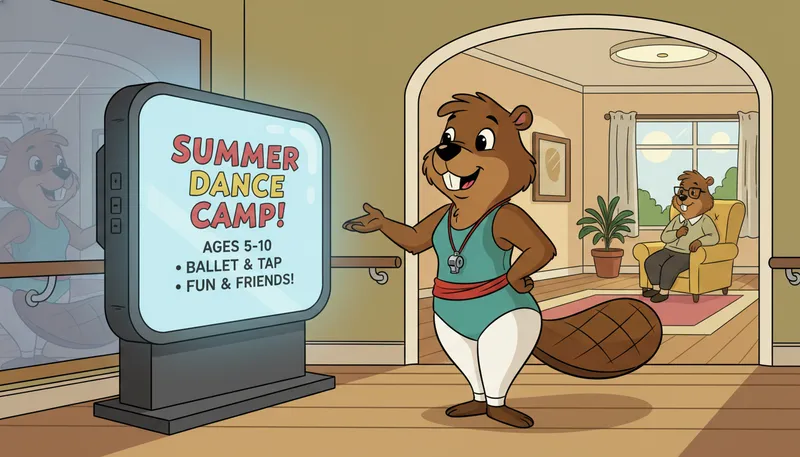
A display in the hallway shows: “Summer Dance Camp: Only 12 Spots Left. Emma S. just registered! Early bird pricing ends Friday. Scan to save your spot.”
Jessica thinks: “Wait, Emma’s signed up? Lily would be crushed if Emma went without her. And only 12 spots? I should do this now.”
What changed: Maria created urgency AND social proof in the three seconds Jessica was paying attention.
Research shows digital displays capture 400% more attention than static signs. But only if the message matches the moment. A Spotlight zone is about quick, high-impact interruption.
Zone 4: Engage
The parent waiting area. The chairs. The 45 minutes of phone-scrolling.
Maria’s Story (The Owner)
“Parents sit in our lobby for 45 minutes every class. That’s hours of attention every week, and they’re all staring at their phones. I wish I could use that time to build excitement for the recital, show off what their kids are learning, get them invested in our community.”
Jessica’s Story (The Parent)
“I’ve got 45 minutes to kill. I could catch up on emails, scroll Instagram… honestly, I’m bored. I glance at the kids through the window sometimes, but I don’t really know what they’re working on.”
The Disconnect
Maria has a TV in the lobby playing cable news. Jessica ignores it. The studio feels like a waiting room, not a community.
The Connection
A display in the waiting area shows a rotation: “Recital Countdown: 47 Days! This week’s rehearsal: Spring Showcase Act 2. Watch a sneak peek…” followed by “Student Spotlight: Meet Lily T., who’s been dancing with us for 3 years…” followed by “Costume Reminder: Measurements due by March 1st. Schedule your fitting at the front desk.”
Jessica thinks: “Oh wow, that’s Lily! And costume measurements. I almost forgot. Let me schedule that now.”
What changed: Maria turned dead time into engagement time. Jessica feels more connected to the studio, and more likely to stay enrolled.
Here’s a bonus: digital signage reduces perceived wait times by up to 35%. Jessica doesn’t just feel informed. She feels like the 45 minutes went faster.
Zone 5: Internal
The instructor breakroom. The staff area. Where your team aligns.
Maria’s Story (The Owner)
“I send emails about what to promote, but instructors don’t always read them. I can’t be at every class reminding them. Last week, three instructors forgot to mention the costume deadline. Now I have angry parents.”
The Instructor’s Story
“I love teaching, but I don’t always know what Maria wants me to say to parents. Am I supposed to push summer camp? Is there a deadline coming up? I find out about things when parents ask me.”
The Disconnect
Maria sends a Monday email. By Thursday, the instructors have forgotten. The team isn’t aligned.
The Connection
A display in the breakroom shows: “This Week’s Focus: Summer Camp (12 spots left, mention at pickup!). Deadline Alert: Costume measurements due March 1st. Parent Script: ‘Have you signed up for summer camp yet? Emma’s already registered!’”
Instructor thinks: “Right, I should mention summer camp when parents pick up. Got it.”
What changed: Maria’s team shows up informed, every class, every day. The whole studio is aligned on the message.
The 5-Zone Framework for Dance Studios
Every zone has two questions: one from you, one from them.
| Zone | Owner’s Question | Parent’s Question |
|---|---|---|
| Welcome | ”How do I reduce front-desk chaos?" | "Where does my kid go?” |
| Discovery | ”How do I make families aware of all our programs?" | "What else do you offer?” |
| Spotlight | ”How do I create urgency for enrollment?" | "Is this worth paying attention to?” |
| Engage | ”How do I use wait time to build community?" | "What’s happening at this studio?” |
| Internal | ”How do I keep my team aligned?” | Staff: “What should I be saying?” |
Your job: Answer their question in a way that serves your goal.
Zones Are Strategies, Not Just Locations
A zone isn’t always one screen in one spot.
You might have multiple Spotlight zones:
- The hallway between studios (catching parents between classes)
- The pickup area (last chance before they leave)
- The front desk counter (impulse registration)
You might have multiple Engage zones:
- The main waiting area (parents during class)
- The viewing window area (parents watching rehearsal)
- The recital venue lobby (during performances)
Think of zones as communication strategies tied to physical areas. The strategy is consistent. The locations can vary.
| Zone Type | Typical Count | Example Locations |
|---|---|---|
| Welcome | 1-2 | Front desk, side entrance |
| Discovery | 1-2 | Lobby, near schedule board |
| Spotlight | 2-3 | Hallways, pickup area, front desk |
| Engage | 1-2 | Waiting area, viewing window |
| Internal | 1 | Staff room |
Why This Works for Dance Studios
Dance studios have a unique advantage: captive attention.
Unlike retail (where customers browse and leave), dance parents are stuck in your building for 45-60 minutes every week. That’s 83% recall rate territory, if you’re showing the right content.
But you also have a unique challenge: two audiences.
| Audience | Where They Are | What They Need |
|---|---|---|
| Parents | Waiting area, hallways, pickup | Program info, deadlines, community |
| Dancers | Hallways, studios | Excitement, recognition, motivation |
Your Spotlight zones might speak to both: “Summer Camp is filling up!” works for parents AND kids. Your Engage zones speak primarily to parents. Your Internal zone aligns your staff to deliver consistent messaging to everyone.
Building Your 5-Zone System
Step 1: Map Your Zones
Walk your studio. For each zone type, identify where that conversation should happen:
- Welcome: Where do families check in?
- Discovery: Where do parents linger and browse?
- Spotlight: Where’s the high-traffic, low-dwell path?
- Engage: Where do parents wait during class?
- Internal: Where does your staff gather?
Step 2: Map Their Questions
At each zone, ask: “What is my parent/dancer wondering right now?”
- Welcome: “Where do I go? Is class on time?”
- Discovery: “What programs do you offer? Is there something for my other kid?”
- Spotlight: “Is this deadline real? Should I act now?”
- Engage: “What’s my kid learning? When’s the recital?”
- Internal: Staff: “What should I be promoting this week?”
Step 3: Map Your Goals
At each zone, ask: “What do I need to happen here?”
- Welcome: Reduce chaos, free up front desk staff
- Discovery: Increase program awareness, upsell classes
- Spotlight: Drive enrollment, create urgency
- Engage: Build community, reduce churn
- Internal: Align team on priorities
Step 4: Write Messages That Serve Both
Each message should answer their question AND advance your goal. If it only does one, rewrite it.
Common Mistakes
Treating Every Screen Like a Billboard
“SUMMER CAMP NOW OPEN!” on every screen all day. Parents tune it out. Use Spotlight for urgency, Engage for depth, Welcome for utility.
Ignoring the Dancer Audience
Your hallway Spotlight zone can speak to kids too: “Summer Camp: Dance all day, make new friends!” Kids are your best advocates. If a dancer wants to go, the parent will register.
Forgetting Internal
Your instructors are your front line. If they don’t know about the costume deadline, they can’t remind parents. The breakroom screen keeps everyone aligned.
Static Content in Engage Zones
Parents are there for 45 minutes. If your waiting area display shows the same slide for 6 weeks, they stop looking. Rotate content: student spotlights, recital updates, behind-the-scenes rehearsal clips.
Frequently Asked Questions
How is this different from the retail 5-zone framework?
The zones are the same, but the application is different. Dance studios have two audiences (parents and dancers), longer dwell times in Engage zones (45-60 minutes vs. 5 minutes at checkout), and enrollment cycles instead of impulse purchases. The messaging strategy adapts to these realities.
What if I only have one screen?
Put it in the waiting area (Engage zone). That’s where you have the most captive attention and the best opportunity to build community. Add Spotlight and Welcome zones as you grow.
How often should I update content?
- Welcome: Update when schedules change
- Discovery: Update seasonally (new programs, new sessions)
- Spotlight: Update with enrollment cycles (weekly during registration pushes)
- Engage: Rotate weekly (student spotlights, recital updates, event countdowns)
- Internal: Update daily or weekly
Can one screen serve multiple zones?
Yes, through dayparting. A lobby screen might show Welcome content during drop-off rush (wayfinding), Discovery content during slow periods (program info), and Engage content during class time (community building).
What content works best in the Engage zone?
- Student spotlights and achievements
- Recital countdowns and sneak peeks
- Instructor bios and teaching philosophy
- Costume and deadline reminders
- Social proof (“15 families have registered for camp!”)
- Behind-the-scenes rehearsal clips
Key Takeaways
- Dance studios have captive attention. Use it or lose it.
- Two audiences (parents + dancers) require zone-specific messaging
- 5 zones, 5 conversations: Welcome, Discovery, Spotlight, Engage, Internal
- Spotlight creates urgency. Engage builds community. Welcome reduces chaos.
- Your instructors are your front line. Keep them aligned with Internal zones.
Bottom Line: The studios that fill their camps and retain their families don’t just teach great dance. They communicate in every zone, meeting parents and dancers where they are, with the message they need to hear.
Ready to Transform Your Studio?
BrandCast helps dance studios coordinate messaging across every zone, so you’re always answering the right question at the right moment.